How AI Thinks
Three Behaviors You Need to Know
Some of this will be familiar. That's the point of a toolkit check: making sure your whole team shares the same mental models before you start building together.
AI has three behaviors that explain most of the surprises people encounter. These aren't limitations to work around. They're the operating constraints that shape how you delegate effectively.
Same Input, Different Output
Ask AI the same question twice and you'll get two different answers. Both reasonable, but different. This is called being probabilistic: AI generates responses based on probability, not exact formulas.
Think of it like...
Asking five colleagues to summarize the same meeting. All accurate, all different, because there are many valid ways to represent the same information.
Takeaway
- Variation is a feature, not a bug. Judge output against your criteria, not against a specific expectation.
- When you need consistency, you need constraints. Vague requests amplify variation; specific ones narrow it. Delegating a vague task twice will produce two different results. That's the next section.
Stateless: No Memory Between Conversations
Every new conversation starts from a blank slate. AI has no memory of previous sessions. The technical term is stateless: nothing carries over from one conversation to the next.
It's like working with someone who's never met you before, every single time.
A note on memory: As of early 2026, some AI tools have begun to incorporate cross-conversation memory. These tools can retain certain information between conversations, but they work by saving key facts, not replaying the full chat history. For now, treat each new conversation as a blank slate. If you need AI to know something, tell it directly - or better yet, use the approach in Section 4.
Takeaway
- Everything you told one AI yesterday is gone today. What you tell one AI assistant won't automatically transfer to the next. Project context, coding conventions, data models: all erased.
- You'll find yourself re-explaining the same things repeatedly. That friction is real, and Section 4 gives you the fix.
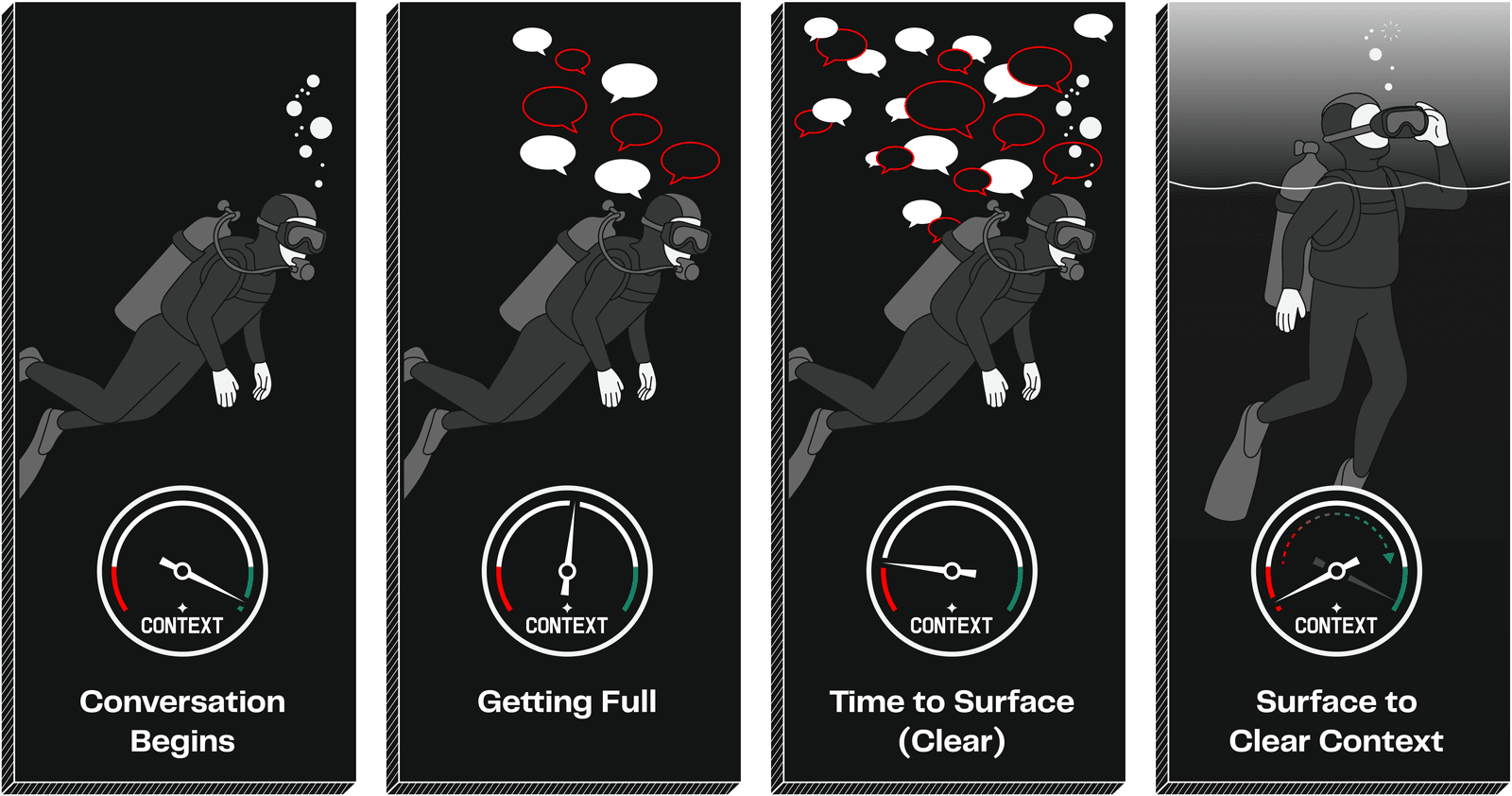
Context Window: The Oxygen Tank
Within a single conversation, AI can hold a limited amount of information in working memory. This is called the context window, measured in tokens (chunks of text).
Think of it like...
An oxygen tank. Every message you or the AI sends uses up air. As the tank runs low, AI starts paying less attention to things in the middle of the conversation. Response quality fades and it may "forget" instructions you gave earlier.
Takeaway
- Long conversations degrade in quality. If AI starts repeating itself or missing earlier instructions, the tank is running low. After 15+ back-and-forth exchanges, watch for this.
- Right-size your requests. Don't spend context on things that don't need to be in the conversation.
In Your AI Assistant
Your AI coding assistant has three built-in commands for managing the tank:
| Command | When to Use |
|---|---|
/new |
Switching to a different task. Starts a new session and resets the tank. Your project files are untouched. |
/compact |
Still on the same task but the tank is getting low. Summarizes the conversation to free space while keeping the thread alive. Add focus instructions like /compact keep the test patterns. |
/sessions |
Returning to a previous conversation. Opens a session picker so you can resume where you left off. Or launch with opencode --continue to resume your most recent session. |
Your AI coding assistant has three built-in commands for managing the tank:
| Command | When to Use |
|---|---|
/clear |
Switching to a different task. Wipes the conversation and resets the tank. Your project files are untouched. (aliases: /reset, /new) |
/compact |
Still on the same task but the tank is getting low. Summarizes the conversation to free space while keeping the thread alive. Add focus instructions like /compact keep the test patterns. |
/resume |
Returning to a previous conversation. Restores the full history so you can pick up where you left off. |
Tip: Type /context in your AI assistant to see how full your tank is.
Your AI coding assistant has built-in commands for managing the tank:
| Command | When to Use |
|---|---|
/clear (or Ctrl+L) |
Switching to a different task. Wipes the conversation and resets the tank. Your project files are untouched. |
/compress |
Still on the same task but the tank is getting low. Condenses the conversation to free space while keeping the thread alive. |
/resume |
Returning to a previous conversation. Opens an interactive session browser so you can pick up where you left off. |
Tip: Type /stats in your AI assistant to check your context usage.
Your AI coding assistant has built-in commands for managing the tank:
| Command | When to Use |
|---|---|
/clear (or /new) |
Switching to a different task. Starts a new session and resets the tank. Your project files are untouched. |
/compact |
Still on the same task but the tank is getting low. Summarizes the conversation to free space while keeping the thread alive. Add focus instructions like /compact keep the test patterns. |
/resume |
Returning to a previous conversation. Opens a session picker so you can pick up where you left off. |
Note: Different AI models have different tank sizes. The assistant in your workspace uses a large context window, but the principle still applies: longer conversations will eventually degrade.
Your AI Experience
Team Discussion | ~2 minutes total
Quick round-the-table: each person shares one thing that surprised or frustrated them when working with AI in the past. Don't solve it yet - just name it.
Discuss: Now that you've seen the three behaviors, can you trace your experience back to one of them? Most "AI is unreliable" moments are actually one of these three constraints in action.
Key Insight
Probabilistic, stateless, limited context. These three behaviors explain most of AI's surprises. They're not flaws. They're the operating manual for your delegate. The rest of this lesson shows you how to work within these constraints instead of fighting them.